
Research Journal III

Updated: Jul 8, 2020
Reconsidering the outcomes of the research conducted on media representations of depression, It is found that there are a lot of distinct recurring visual expression of the mental disorder especially in personal media which denote person to person communications such as blogs and forums and also in videos that portray first person perspective of depression. It is important to note the form of media, as they may have varying function and audience.
Depression is the mental illness that is most commonly portrayed in media, while non-fiction news outlet have a more thematic approach rather than personal episodes, fictional media tend to use more stigmatizing terms, both of which lead to negative outlook on the issue. According to Diefenbach and West (2007) it is believed that television portrayals of mental illness had greater effects on others than themselves. Study by Hoffner et al. (2017) also suggest that third person perceived negative influence of news on others’ attitudes, was more salient if people had more prior personal experience with mental illness. However, research have found that mental illness and advocacy action is increasingly discussed in the media, gradually changing public perspective on people with mental illnesses.
On the other hand, media sources studied such as lyrics, 2D animations and short films from individuals or small production company take a more personal approach to the topic and similar metaphorical terms were used to better reflect their emotions and thoughts. Based on The Chicago School Of Media Theory (Neziroski, 2003), narrative, drama and lyrics both fall into the three general literary forms into which writing, especially poetry, has traditionally been grouped. Generally, lyric is loosely defined as any short poem and lyric poets rely on personal experience, close relationships, and description of feelings as their material (Neziroski, 2003)⁶. Therefore, I would like to create a generalized depiction based on the recurring elements of personal account to evaluate my own interpretation in comparison with both mass media and personal media.
The project essentially revolves around the representation around the individual’s description of their personal experiences. After research on the representations of depression through various art forms, it is found that while there were various expression of depression, there were not many that involves the audience. Through the discovery of Ari Folman’s Depression Chamber (2017) and Sharon Howard-Butler’s immersive art installation on schizophrenia, it is deduced that immersive works are able to influence audience emotionally, thus in order to better express the inner realms of the individuals, the medium of virtual reality will be used for this project. The sharing of personal experience with others can be enhanced through a fully immersive virtual visualization of depression through the eyes of those haunted by depression. Viewers can get emotionally immersed when they are absorbed into the narrative content of the story in addition to the spatial immersion created by the virtual environment, through such interaction perhaps people could gradually come to empathise with those with depression and come to understand each other more profoundly.
Virtual reality is increasingly being adopted into the medical field and is being used as treatment for mental health. A research funded by U.K. Medical Research Council grant used attempted to help patients overcome self-criticism showed success through immersive virtual reality intervention sessions. Participants was initially embodied in to a virtual body and instructed to deliver compassionate response to a child in the virtual replica of the room and later re-experience their own consolation from the perspective of the child. Virtual reality allows participants an opportunity to experience situations and view things from a different perspective. DEEP is a virtual reality game for anxiety and depression encourages players to become aware of the flow of these emotions and ride them through rather than getting rid of depression. Players move through a serene underwater world with each controlled breath, through repeated experience player would hopefully retain “muscle memory” of deep diaphragmic breathing and the optimism of riding through future stressful experiences (Granic, 2017). In Singapore, a programme, Do You M.I.N.D. gave secondary students a chance to listen to the thoughts of depression through VR to initiate discussions on the topic as according to National Training Laboratory, VR Training yielded 75% retention rate as compared to the 5% and 10% rate for lecture-style learning and reading respectively (Choo, 2018).
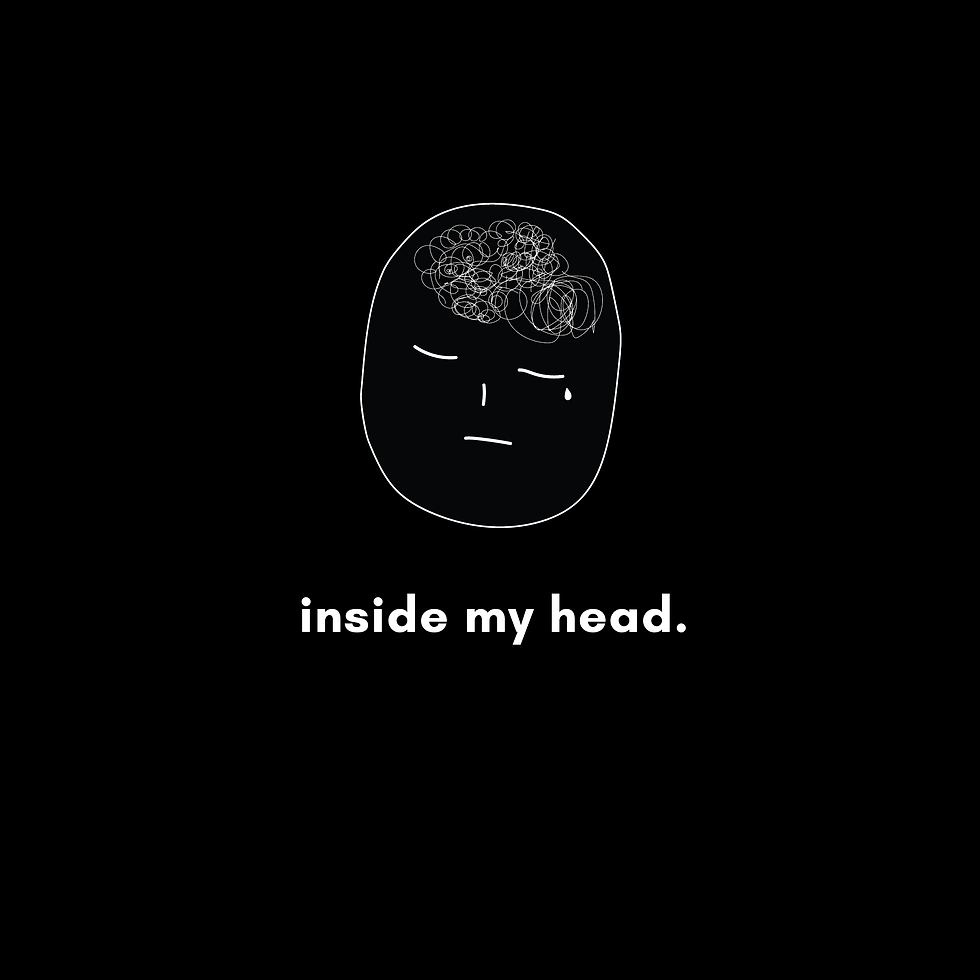
Inside My Head project incorporates elements from all three of the above VR depression projects, the self awareness of negative mental imagery for the participants and experiencing it through the eyes of those who did through an immersive atmospheric environment. While DEEP intended for a healing environment, my virtual realm, attempts to depict the bleak experience of depression itself. The visual content will encapsulate elements from the submitted narratives and depression forum that corresponds to the lyrical and visual metaphors, creating an inclusive and relatable experience for viewers who have had experienced the mental illness and provide an emotional insight for those who have not. If the virtual experience intend to unshroud the public’s stigma surrounding the mental disorder and consider it an integral part of health, the accuracy of the representation should be considered by consulting with individuals who submitted the narratives. However, as the first and foremost intention of the project is also to study and compare the representation of depression I would have to try to strike a balance between the two objectives when creating the virtual environment.
After laying out the justification and directions of the project, the focus will now be mainly on realizing the virtual experience. The idea is to bring together the common symbols and metaphors used to describe depression. Instead of allowing players to freely navigate through the space, they will be transported to a next scene or set off movements unknowingly to reflect how we cannot always spot warning signs of depression or might even fall into it without noticing. The space is meant to large, dark and empty, focusing more on the atmosphere. The VR project will rely more on scripts instead of just visual object designing to create an immersive experience. With reference to the narratives written by the individuals, I will attempt to make a relatable and generalized experience, however It will be challenging to make people ‘feel’ instead of just ‘seeing’.
References
Choo, F. (2018) ‘Secondary school students to learn about depression through virtual reality experience’, The Straits Time, October 30. Available at: https://www.straitstimes.com/singapore/health/secondary-school-students-to-learn-about-depression-through-virtual-reality (Accessed: 9 April 2019)
Diefenbach, D. and West, M. (2007). ‘Television and attitudes toward mental health issues: Cultivation analysis and the third-person effect’, University of North Carolina at Asheville, February 8. Available at: https://onlinelibrary.wiley.com/doi/pdf/10.1002/jcop.20142 (Accessed: 19 March 2019)
Granic, I. (2017) ‘DEEP-VR: A stunning virtual reality game for anxiety and depression (Pt. 5)’, It’s Your Turn, July 16. Available at: https://itsyourturnblog.com/deep-vr-a-stunning-virtual-Reality-game-for-anxiety-and-depression-pt-5-16801d6830c9 (Accessed: 9 April 2019)
Hoffner, C. A., Fujioka, Y., Cohen, E. L., & Atwell Seate, A. (2017). ‘Perceived media influence, mental illness, and responses to news coverage of a mass shooting’, Psychology of Popular Media Culture, 6(2), 159-173. Available at: http://dx.doi.org/10.1037/ppm0000093 (Accessed: April 25 2019)
Neziroski, L. (2003). ‘narrative/lyric/drama’, The Chicago School of Media Theory, Available at: https://lucian.uchicago.edu/blogs/mediatheory/keywords/narrativelyricdrama/ (Accessed: 19 March 2019)
Comments